
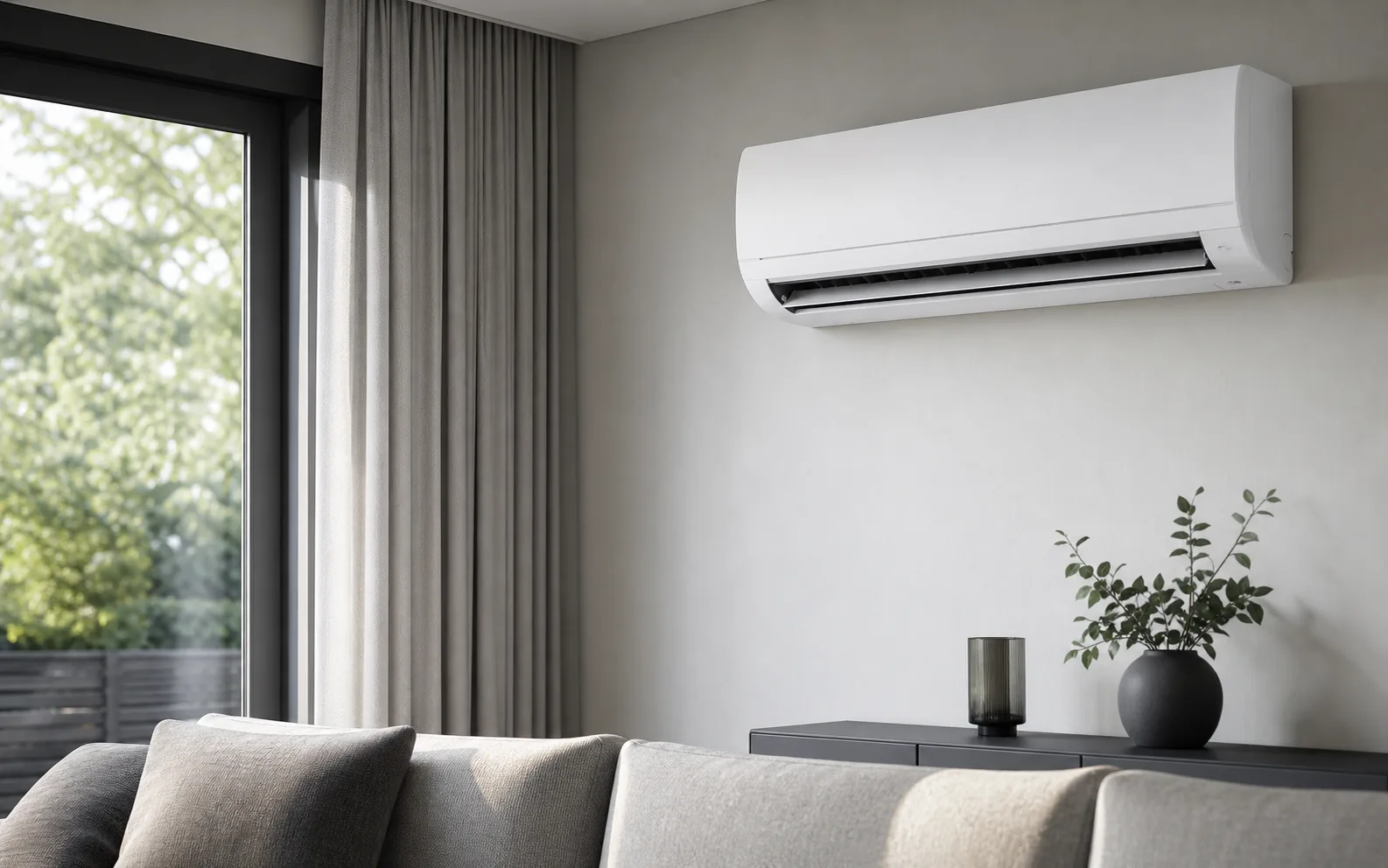
Most homeowners who enquire about domestic air conditioning have one of two priorities: a bedroom that remains uncomfortable long after sunset, or a home office that becomes difficult to use on warm afternoons.
Both spaces benefit from the same approach: choose the smallest correctly sized system that can maintain comfort quietly, then plan the indoor unit, outdoor unit, pipe route, drainage and controls as one installation.
Why a split system is usually the right starting point
A single-split system connects one indoor unit to one outdoor unit. It is generally quieter, more efficient and less intrusive than a portable air conditioner, while many modern systems can also provide supplementary heating during cooler weather.
A multi-split system may suit a home with two or more rooms, but it needs more design work. Simultaneous demand, pipe routes and the outdoor unit position all affect whether one coordinated system or separate single splits are the better choice.
Noise matters most in bedrooms
Published sound levels are useful, but they are only part of the result. An oversized unit can cycle more noticeably, while poor airflow positioning can create draughts even when the equipment itself is quiet.
The survey should consider where the bed sits, which wall is suitable, whether air can move across the room without blowing directly at the occupants and where the outdoor unit can operate without disturbing bedrooms or neighbours.
What determines the correct size?
Floor area is only a starting point. Ceiling height, glazing, window orientation, insulation, occupancy, computers and other internal heat gains all influence the cooling load. Loft rooms and south-facing spaces often need particular care because heat builds up faster than in shaded ground-floor rooms.
A correctly sized system should maintain the target temperature steadily rather than blasting the room with cold air and repeatedly switching on and off.
Home office considerations
Home offices add heat from computers, monitors and occupants, often in a smaller room with the door closed. The indoor unit should avoid blowing directly over a desk, and controls should make it easy to adjust the system during calls or focused work.
If the room is used all year, the heating mode may also be useful. The design still needs to account for the wider heating strategy rather than treating an AC unit as a direct replacement for the main system.
Guide prices in Bristol
- Single bedroom or home office: from £1,599 installed
- Selected two-room systems: from £2,499 installed
- Larger multi-room planning: from £3,499 installed
Access, electrical work, condensate drainage, pipe length and the outdoor unit position can change the final price. A clear proposal should show what is included and any assumptions made.
F-Gas certification and servicing
Refrigerant work must be completed through the correct F-Gas qualified pathway. ELUVO Ltd is an F-Gas certified company (F-Gas ID FGAS3028698), verifiable through the official F-Gas Register company directory.
After installation, filters, drainage, indoor-unit hygiene, controls and system performance should be checked regularly. Planning annual service access during the original design makes long-term ownership easier.