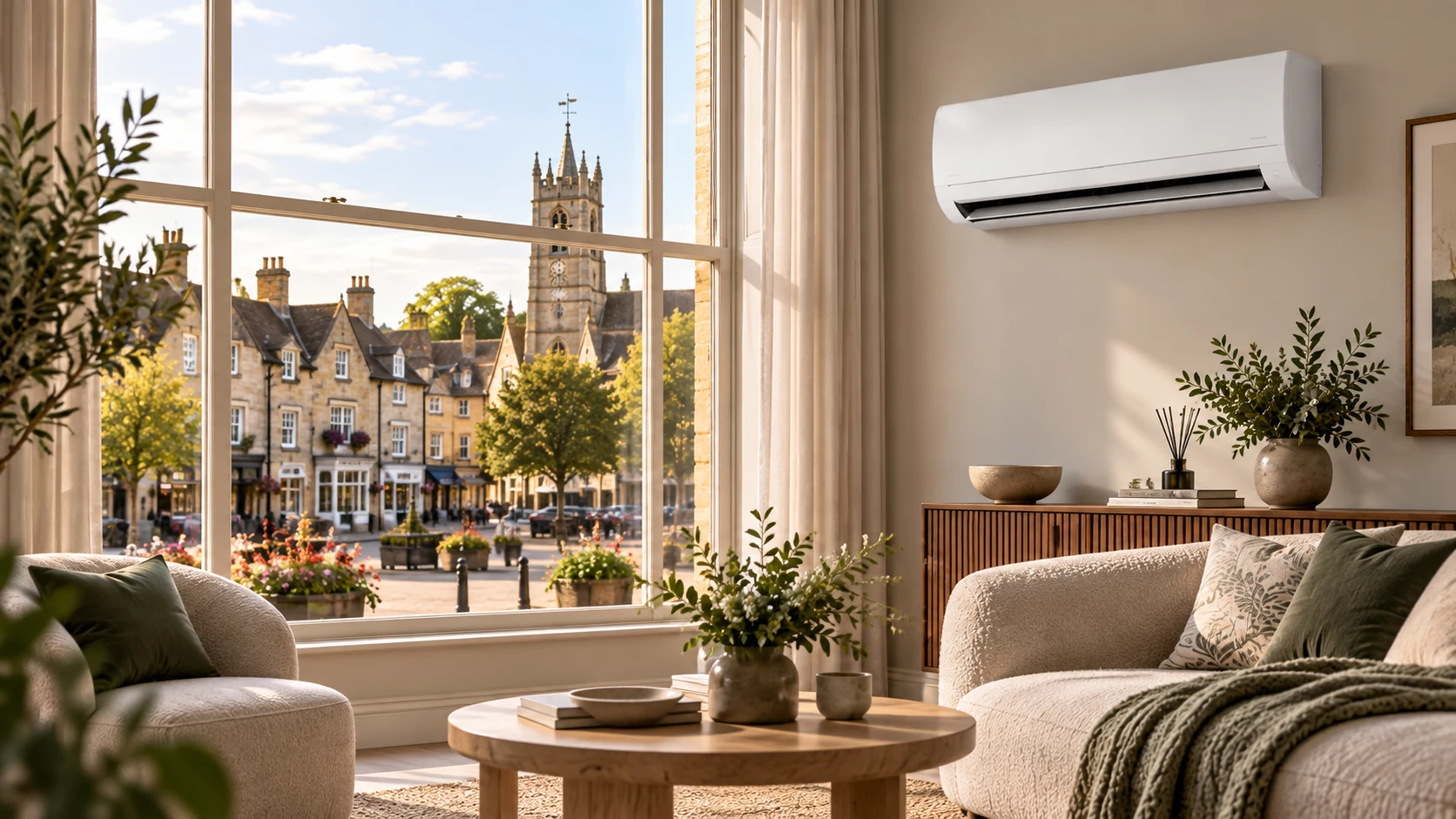
Traditional buildings with higher heat loss
Stone cottages, older terraces and historic properties can have solid walls, traditional windows and room layouts that respond differently from modern cavity-wall homes.
ELUVO IN CHIPPING SODBURY
Chipping Sodbury’s medieval market-town core, long burgage plots, stone cottages and later family housing create a very different home-comfort landscape from neighbouring Yate.
ELUVO plans heating, cooling and future upgrades around the individual property — from historic town-centre homes to conventional suburban houses and newer extensions.
Local Overview
Chipping Sodbury is one of South Gloucestershire’s clearest examples of a town whose medieval structure still shapes modern property decisions.
South Gloucestershire’s adopted conservation guidance describes the town as a planned medieval market settlement with an exceptionally well-preserved layout. The broad High Street and market space are backed by long, narrow burgage plots that extend away from relatively narrow street frontages.
That pattern is more than historical interest.
It can affect access, gardens, rear routes, extensions and the position of external equipment. A property may have a generous-looking plot on a plan but still present a narrow route from street to rear. Outbuildings, boundary walls, neighbouring plots and historic garden patterns can all influence where pipework or outdoor equipment can sensibly go.
Horse Street creates another distinct condition. The conservation guidance describes a much narrower, more enclosed street where taller buildings, cottages and small gardens replace the scale of the market street before the town transitions toward a more rural edge.
Beyond the historic centre, Chipping Sodbury includes later twentieth-century and more conventional family housing. Those properties can be much simpler to work with physically, but they bring the familiar issues of extensions, ageing boilers, changing hot-water demand, loft conversions and rooms that now serve a very different purpose from the original floor plan.
The result is a compact town with several very different building types.
ELUVO’s approach is to identify which type of property we are dealing with before deciding what the heating or cooling solution should be.
Comfort Problems
Stone cottages, older terraces and historic properties can have solid walls, traditional windows and room layouts that respond differently from modern cavity-wall homes.
Long burgage plots and historic boundaries can make the physical route from indoor equipment to an external location more important than the straight-line distance suggests.
A period house may now contain a modern kitchen extension, loft room or additional bathroom even though the radiator circuit and pipework were designed for an earlier layout.
Some established family homes have different levels of insulation or different glazing across the building, which can leave one side of the property cooler or warmer than another.
Roof exposure and converted loft spaces can create summer overheating even where the ground floor remains comfortable.
Modern rear additions can be thermally very different from the original house. Large doors, rooflights and open-plan spaces can create both winter heating and summer cooling challenges.
Boiler Installation
A straightforward suburban boiler replacement and a boiler upgrade inside a historic market-town property can require very different levels of planning.
In an older property, ELUVO may need to look more closely at radiator output, legacy pipework, chimney or flue history, condensate routing and the relationship between the original building and later additions.
In a more conventional family home, the key questions may instead be hot-water demand, control strategy, extension loads and whether the existing system still suits the way the house is occupied.
The boiler should be selected around the actual property rather than simply copied from the appliance being removed.
Our survey considers:
Where an issue elsewhere in the system is likely to reduce the benefit of the new boiler, it should be identified before the work is committed.
Boiler Service & Repair
Annual servicing gives the homeowner an opportunity to keep track of the condition and operation of the boiler before winter demand exposes a problem.
But servicing and diagnosis are not the same job.
If a boiler is repeatedly losing pressure, locking out, producing inconsistent hot water or behaving differently from normal, the cause may sit elsewhere in the heating system.
That can be particularly relevant in older homes where radiators, controls and pipework have been changed over many years.
ELUVO separates routine maintenance from fault finding and explains what has actually been observed.
Where the boiler remains healthy, we maintain it. Where the symptom points to another part of the system, the homeowner should understand that before replacing equipment unnecessarily.
Air Conditioning
Historic housing is often associated with winter heat loss, but older homes can still have summer comfort problems.
Upper rooms, converted lofts and west-facing bedrooms can become warm during sustained hot weather. Modern extensions attached to older houses can create even stronger solar gain through large areas of glass.
In newer homes, the issue may be heat retained by modern insulation and limited natural ventilation rather than traditional construction.
Chipping Sodbury already has a dedicated ELUVO Air Conditioning page covering local system planning, installation routes, pricing and the AirCon Wizard.
Heat Pump Readiness
Chipping Sodbury contains homes that start from very different positions for heat-pump planning.
A historic stone cottage may need more attention to heat loss and radiator output. A later suburban house may be easier to work with but still have an ageing emitter system or controls that were never designed for lower-temperature heating.
The physical site matters too.
Long historic plots, narrow access, prominent elevations and neighbour relationships may influence where an outdoor unit can go, while newer housing may have tighter boundaries even where the building fabric itself is more efficient.
ELUVO’s readiness review considers:
The result is not automatically “yes” or “no”.
A useful readiness plan may identify one or two changes that should happen first so that a future heat pump has a better chance of operating well.
Home Climate Assessment
A home can contain a modern boiler, replacement windows, a recent kitchen extension and smart controls while still retaining the thermal characteristics of an older original building.
That mix is common in established towns.
The ELUVO Home Climate Assessment looks at the whole property rather than focusing immediately on one product.
For a Chipping Sodbury home, that may mean understanding:
The purpose is to create a sequence of sensible improvements.
Sometimes the first step is a boiler replacement. Sometimes it is controls, emitters or maintenance. Sometimes a room-specific cooling solution is more appropriate than changing the whole heating system.
ELUVO Care
As systems are upgraded, homeowners can end up with separate service histories for the boiler, controls and cooling equipment.
ELUVO Care is intended to keep ongoing maintenance, service history and recommendations more organised.
That becomes increasingly valuable in a home that is changing over time.
The objective is simple: know what has been installed, know what has been serviced and know what may need attention next.
Local Neighbourhoods
The wide historic market streets are the defining urban feature of Chipping Sodbury.
Properties here can combine historic façades, narrow frontage plots and long rear gardens. Any visible external work, rear route or future equipment position should be considered in relation to that historic pattern rather than treated like a standard modern plot.
Horse Street changes quickly from the broad market-place character to a narrower, more enclosed residential street of older buildings, cottages and small gardens.
For heating and cooling work, access, façade sensitivity, small external spaces and close relationships between properties can be particularly important.
The streets leading from the historic market area tend to have a more residential character and act as transitions between the core and later development.
Homes can vary considerably in age and layout, so external routes and heating-system assumptions should be checked from the property itself.
The long narrow plots behind parts of the historic frontage are a distinctive feature of the town’s medieval plan.
Rear access, existing extensions, garden buildings and neighbouring boundaries can influence the practical route for services and outdoor equipment.
West of the historic core, Chipping Sodbury becomes physically connected with Yate, but the two places retain distinct identities and building patterns.
Later family housing can provide more conventional boiler and heat-pump layouts, while extensions, loft conversions and ageing systems still need proper assessment.
The eastern side of Chipping Sodbury transitions toward open countryside and the setting of the Cotswold landscape.
Properties here may have larger plots or a more open setting, but visible equipment, exposed elevations and individual construction types can still make system design property-specific.
Planning & Property Status
Chipping Sodbury has a clearly defined conservation area centred on the historic market town.
South Gloucestershire’s adopted guidance describes the special character of the medieval plan, the broad market street, burgage plots, historic buildings and the transition from the town into surrounding countryside.
This matters most where proposed work affects visible external elevations, historic fabric, important gardens or the pattern of the historic plots.
It does not mean every home in Chipping Sodbury is subject to the same restrictions.
Later residential areas outside the historic core can have a much more conventional planning context, while individual properties may still be listed, leasehold or subject to other constraints.
For air-conditioning or heat-pump outdoor equipment, the correct approach is to check the individual property and position rather than rely on a blanket statement.
ELUVO can assess technical routes and identify obvious constraints during survey.
Formal planning, listed-building and conservation decisions remain with the relevant authority.
FAQ
Potentially, yes. The technical route needs to suit the building, and listed or conservation-sensitive properties may require additional checks before visible external work is carried out.
No. Boiler selection should be based on actual heat and hot-water demand. Older fabric may increase heat loss, but radiator output, controls, zoning and system condition are also important.
Potentially. The main issues are indoor-unit position, route, drainage, outdoor-unit location, visibility, noise and the property’s planning or heritage status. The dedicated Chipping Sodbury AC page covers this in more detail.
Not necessarily, but the route can be less obvious. Narrow access, existing extensions, garden buildings and historic boundaries may affect where pipework or outdoor equipment should go.
Some may be strong candidates, but suitability still depends on heat loss, emitter output, hot-water use, controls and outdoor-unit position. A conventional suburban layout does not guarantee readiness.
Often, yes. The right answer depends on the cause. It may involve radiator output, balancing, controls, building fabric or targeted cooling.
No. Internal heating upgrades may be straightforward, while visible external changes can require more consideration. The specific property and work need to be checked.
If the requirement is already clear, a quotation may be enough. If the property has several linked issues — for example an ageing boiler, a modern extension, uneven heating and future heat-pump plans — the Home Climate Assessment is usually the more useful starting point.
The ELUVO Approach
Chipping Sodbury’s historic core has survived because its town plan and building character remain unusually legible.
But the homes are still lived in, extended, heated and adapted for modern life.
The right result is not achieved by pretending a period home should behave like a new build — or by assuming that modern comfort cannot be introduced sensitively.
ELUVO approaches boiler replacement, servicing, air conditioning, heat-pump readiness and whole-home assessment as connected decisions.
The next step may be a simple service visit. It may be a boiler quotation. It may be targeted cooling for one room. Or it may be a broader assessment to decide how a mixed-age property should evolve.
READY TO START?
Tell us what is happening in the property and what you want to improve. We will help determine whether the right next step is a quotation, service visit or Home Climate Assessment.
ELUVO service areas
Talk To ELUVO
Tell us what you need help with. We will review your enquiry and confirm whether a quote, service visit or technical assessment is the right next step.
Free initial phone consultation.
Professional Home Climate Assessments start from £95 and are credited back when you proceed with installation.