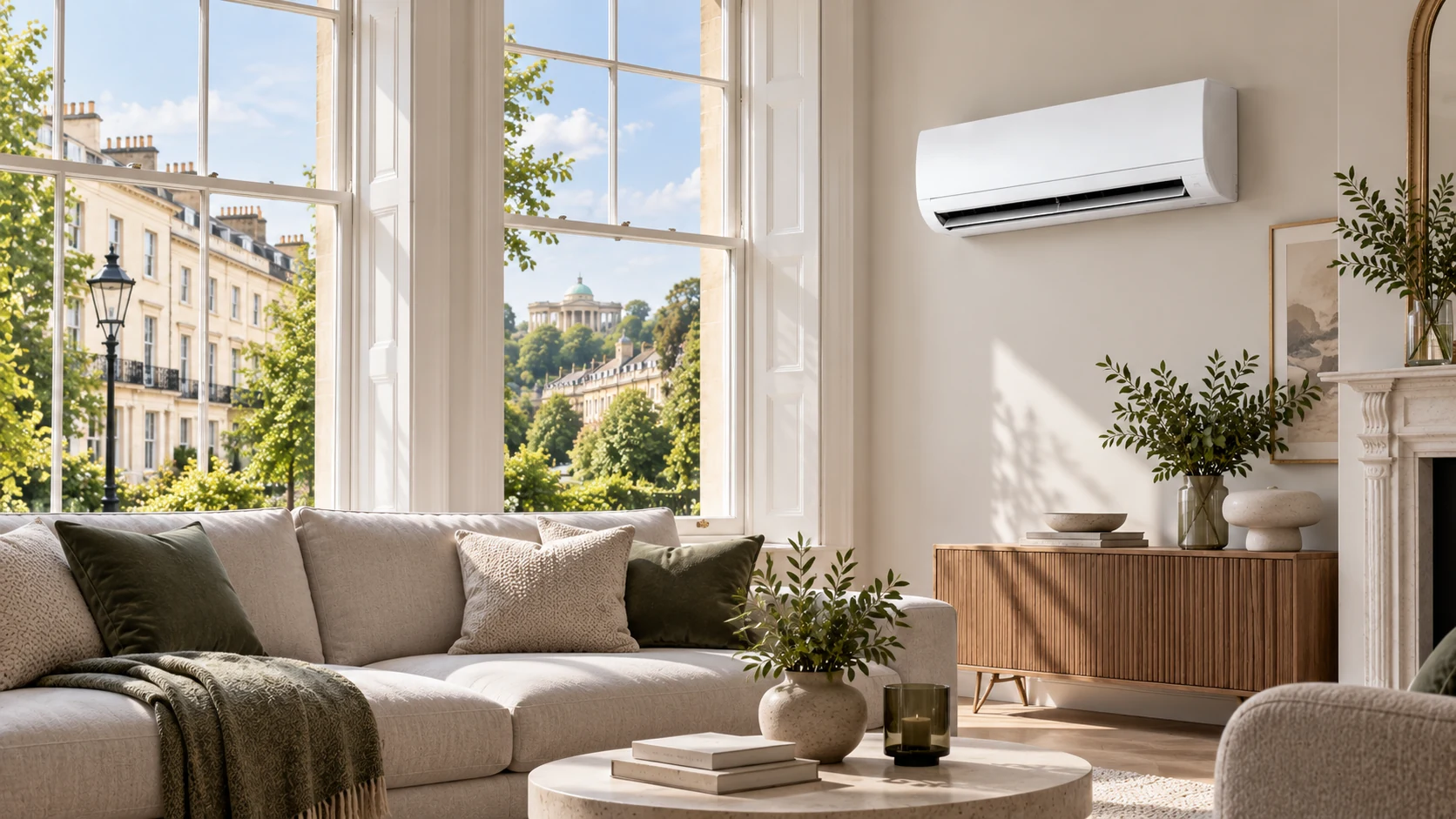
Tall rooms and multi-storey period properties
Large internal volumes can make radiator sizing, zoning and heat distribution more important than in a compact modern house.
ELUVO IN CHELTENHAM
Cheltenham combines Regency terraces and villas, Victorian and Edwardian neighbourhoods, garden-suburb housing and later twentieth-century family estates within one of the South West’s most distinctive urban landscapes.
That variety means heating and cooling work must respect both the building and the way it is used today. ELUVO looks at the property, the existing system and the homeowner’s longer-term plan before recommending what should be serviced, replaced or improved.
Local Overview
Cheltenham’s identity is strongly tied to its Regency and nineteenth-century growth, but the town’s housing is far more varied than its best-known terraces and crescents suggest.
The central conservation area is exceptionally large and includes the town centre as well as substantial areas of Victorian, Edwardian and some later twentieth-century development. Cheltenham Borough Council divides this central area into multiple distinct character areas including Montpellier, Lansdown, Pittville, Bath Road, The Park, St Paul’s, Leckhampton, Fairview and others.
These areas contain different building forms and therefore different comfort problems.
A Regency townhouse may have tall rooms, sash windows, solid masonry, multiple floors and sensitive street-facing elevations. A Victorian terrace may have more compact rooms but still contain traditional fabric and several generations of heating work. Garden-suburb housing in areas such as The Poets was planned around wider plots and Arts-and-Crafts influences. Later suburban neighbourhoods can have more conventional cavity-wall construction and easier installation routes.
The result is a town where two homes a few streets apart can need very different solutions.
ELUVO does not begin with the product.
We begin with the building, how heat moves through it, how rooms are occupied and what the homeowner wants the property to become over time.
Comfort Problems
Large internal volumes can make radiator sizing, zoning and heat distribution more important than in a compact modern house.
Older building fabric can contribute to higher heat loss and room-to-room variation.
A period property may have a modern boiler, older radiators, smart controls and a later extension, all added at different times.
Top-floor bedrooms and converted attics can overheat during prolonged warm weather.
Historic façades and prominent streets can make flue routes and outdoor-unit positioning more important.
Garage conversions, rear extensions and open-plan living can change the heating demand well beyond the original design.
Ownership, shared walls and freeholder or management-company approval can be separate from the technical design.
Boiler Installation
A boiler project in a Regency townhouse requires different thinking from a later suburban semi.
In older properties, ELUVO may need to consider:
In later homes, the key issues may be extensions, hot-water demand, control strategy and future lower-temperature heating.
ELUVO reviews:
The objective is not simply to replace the appliance. It is to make the heating system work more coherently for the home as it exists now.
Boiler Service & Repair
A routine service is appropriate when the boiler is operating normally and needs planned maintenance.
If the system is losing pressure, locking out, producing inconsistent hot water or heating rooms unevenly, the problem may involve more than the boiler.
That is especially relevant in older Cheltenham properties where the wet system may be much older than the current appliance.
ELUVO separates service from diagnosis and explains what has actually been observed before recommending repair or replacement.
Air Conditioning
Upper-floor bedrooms, roof rooms, home offices, west-facing spaces and modern glazed extensions can all become uncomfortable during warm weather.
In period properties, the challenge may be less about whether cooling would help and more about introducing it discreetly.
In newer homes, better insulation can retain unwanted summer heat.
Heat Pump Readiness
Cheltenham contains homes that range from traditional Regency masonry to later suburban construction.
ELUVO reviews:
A period townhouse may need emitter and fabric work first.
A later cavity-wall home may offer an easier route but still require proper design.
The useful outcome is a readiness plan, not a postcode-based assumption.
Home Climate Assessment
A Cheltenham home may contain traditional windows in one area, modern glazing elsewhere, a newer boiler, old radiators, a rear extension and a loft conversion.
Those changes can create comfort problems without one obvious failed component.
The ELUVO Home Climate Assessment can identify:
The purpose is to create the right sequence of improvements.
ELUVO Care
ELUVO Care helps bring service records, reminders and future recommendations together across heating and cooling systems.
Local Neighbourhoods
One of Cheltenham’s best-known historic areas, with terraces, villas and prominent architectural character.
Traditional fabric, tall rooms and visible external elevations make route planning more sensitive.
Period housing, larger villas and strong heritage context can create multi-zone heating and external-equipment questions.
Large period homes and terraces can have substantial hot-water demand, tall room volumes and mixed heating histories.
Dense urban housing, terraces and rental properties can create compact routes and higher-occupancy heating demands.
Cheltenham’s only current Article 4 Direction applies to HMO conversion in a defined St Paul’s area. It is not a general HVAC restriction.
A mix of historic, Edwardian and later family housing creates different heat-loss and extension profiles.
Older village character, conservation areas and later suburban housing sit side by side.
Planned post-First-World-War garden-suburb housing includes Arts-and-Crafts influences and more regular family-home plots.
Planning & Property Status
Cheltenham has seven conservation areas, including the very large Central Conservation Area.
That central area covers around 599 hectares and includes many distinct neighbourhoods and building types.
Conservation status does not mean every heating or cooling project requires planning permission.
It does mean visible external changes may need more careful consideration.
Cheltenham currently has one Article 4 Direction, in St Paul’s, and it relates specifically to change of use from a dwellinghouse to a small HMO.
ELUVO can assess technical routes and identify obvious property-status questions.
Formal planning, listed-building and conservation decisions remain with Cheltenham Borough Council.
FAQ
Yes, potentially. The system needs to reflect heat loss, room volume, emitter performance and the specific building.
No. Boiler output should follow actual heating and hot-water demand.
Potentially. External-unit position, visible routes and property status need to be checked.
Some are already good candidates; others may need emitter, control or fabric improvements first.
No. The current Article 4 Direction concerns conversion from C3 dwellinghouse use to C4 HMO use in a defined area.
Potentially. Different floors and room uses can benefit from more considered control.
They can offer more conventional plots, but system age, extensions and emitters still need assessment.
Use a standard quote when the required service is clear. Use the Assessment when several comfort or future-upgrade questions need to be prioritised.
The ELUVO Approach
The town’s Regency character, Victorian growth, garden suburbs and later estates all create different technical starting points.
ELUVO connects boiler installation, servicing, air conditioning, heat-pump readiness and whole-home planning around the individual property.
ELUVO service areas
Talk To ELUVO
Tell us what you need help with. We will review your enquiry and confirm whether a quote, service visit or technical assessment is the right next step.
Free initial phone consultation.
Professional Home Climate Assessments start from £95 and are credited back when you proceed with installation.