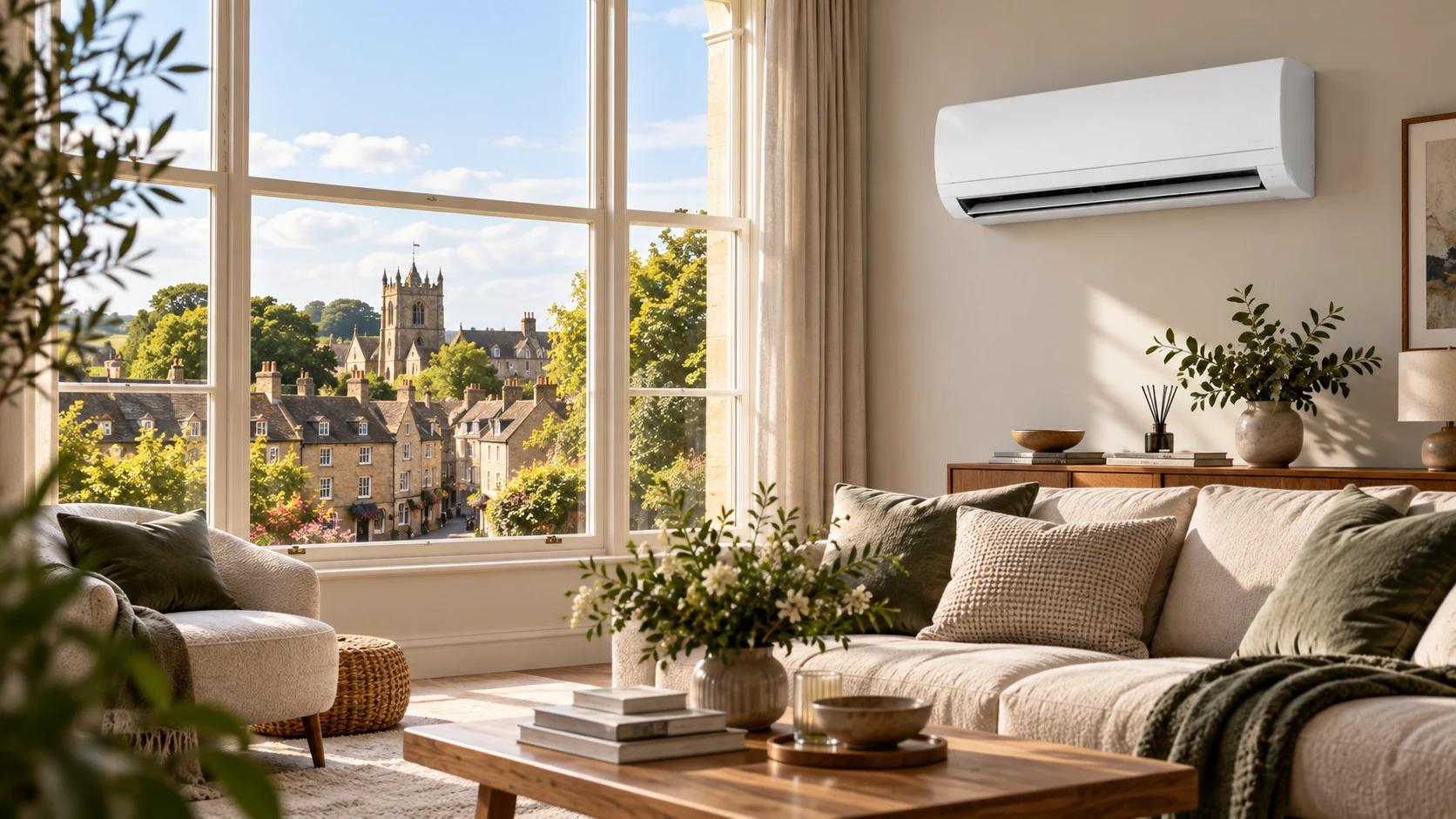
Traditional buildings with mixed thermal performance
Older masonry, traditional windows and rooms of different sizes can create uneven heating demand. Two rooms in the same house may behave very differently depending on orientation and exposure.
ELUVO IN THORNBURY
Thornbury combines a remarkably intact medieval market-town core with stone-walled plots, historic houses, twentieth-century estates and newer family developments around the town’s edges.
That mix means the right heating or cooling solution can vary dramatically from one street to the next. ELUVO plans around the property, the existing system and the way the home is actually used.
Local Overview
Thornbury’s historic character is unusually legible.
South Gloucestershire’s conservation guidance traces the town’s medieval form to the thirteenth century, with Castle Street, High Street and The Plain converging on the historic market area. The same guidance highlights surviving burgage plots, narrow rear boundaries, substantial stone walls and the open closes that historically sat behind the town.
For homeowners, that urban form is not simply heritage background.
Long plots, enclosed rear gardens, boundary walls and older outbuildings can determine where services can be routed and where external equipment can sensibly be located. A home may be close to the road at the front but extend a long distance behind it. The practical route for condensate, pipework or an outdoor unit can therefore be very different from a conventional suburban plot.
Around the castle, church and historic centre, the setting itself can also matter. Visible alterations and external equipment need to be considered more carefully where the building or streetscape carries historic significance.
But Thornbury is not only its medieval centre.
South Gloucestershire planning material records extensive housing growth through the 1960s, 1970s and 1980s. More recent development has also extended the town around areas such as Morton Way and Crossways.
That gives Thornbury a broad spread of property types: older stone and rendered houses, town-centre terraces, mid-century family homes, later estates and newer houses with modern insulation and controls.
ELUVO’s approach is to identify which version of Thornbury the property belongs to before deciding what the next heating or cooling step should be.
Comfort Problems
Older masonry, traditional windows and rooms of different sizes can create uneven heating demand. Two rooms in the same house may behave very differently depending on orientation and exposure.
Historic burgage patterns and substantial walls can complicate external routes, especially where the easiest technical path would be visually or practically unsuitable.
A period property may have accumulated several generations of heating work: new boiler, old radiators, revised pipework, smart controls and a modern extension all operating together.
Homes from Thornbury’s twentieth-century expansion can have conventional layouts but older radiator circuits, historic boiler replacements and controls that no longer reflect current room use.
Rear kitchen-diners, rooflights and large doors can create a very different heating and cooling load from the original property.
Newer construction can hold heat well. That is useful in winter, but upper bedrooms and home offices can remain warm long after outside temperatures fall.
Boiler Installation
A boiler replacement in a modern Thornbury estate house may be relatively straightforward.
In a historic property, the same job can require more investigation.
Older homes may have radiators installed at different times, mixed pipework, limited plant-space options and routes constrained by walls, chimneys, historic fabric or later extensions. Larger homes may also place more demand on hot-water performance and zoning.
ELUVO reviews the existing system before specifying the replacement.
We consider:
Where the boiler is only one part of the weakness, that should be identified before installation.
A good replacement should improve the way the heating system works as a whole, not simply reproduce the specification of the old appliance.
Boiler Service & Repair
Annual servicing is an opportunity to keep the boiler’s operation and condition visible.
It is not the same as investigating a fault.
In an older or repeatedly altered heating system, symptoms such as pressure loss, poor circulation or uneven heat can appear to be a boiler problem even when the cause sits elsewhere.
ELUVO separates routine service work from diagnostic work.
Where the appliance is operating normally, we maintain it.
Where there is a recurring problem, we look for evidence before recommending repair or replacement.
That is particularly valuable in homes where radiators, controls and pipework may be much older than the boiler itself.
Air Conditioning
Thornbury’s older homes can be cool in winter but still uncomfortable upstairs in summer.
Roof rooms, west-facing bedrooms, converted lofts and modern glazed extensions can all build up heat during warm weather.
Newer homes can have the opposite problem: low winter heat loss but rooms that retain internal and solar heat for too long.
Thornbury already has a dedicated ELUVO Air Conditioning page covering system design, local installation considerations, pricing and the AirCon Wizard.
Heat Pump Readiness
Thornbury’s suburban and edge-of-town housing can provide useful outdoor space for low-carbon heating equipment.
That can be an advantage.
But a practical garden position does not answer the other important questions.
An older home may have high heat loss or radiators sized for hotter water. A 1970s or 1980s house may have been improved in stages. A newer property may have a stronger fabric envelope but still need its hot-water demand, controls and emitter capacity checked.
For heritage-sensitive properties, the appearance and position of external equipment may also matter.
ELUVO assesses:
The result should be a practical readiness plan.
For some homes that may mean a direct route.
For others it may mean better controls, radiator upgrades or fabric work before changing the heat source.
Home Climate Assessment
Thornbury contains many homes where the building and the heating system have evolved at different speeds.
A historic house may have modern windows in one part, original masonry elsewhere, a recent boiler, older emitters and a large rear extension.
A mid-century house may now contain a conservatory replacement, converted garage, home office and different controls from those originally installed.
The Home Climate Assessment looks across those changes rather than focusing immediately on one appliance.
For a Thornbury property, that can mean reviewing:
The purpose is to establish an order of work.
That is often more valuable than replacing the most visible piece of equipment first.
ELUVO Care
Home systems rarely stay static.
A boiler may be replaced first. Air conditioning may be added to a bedroom later. Controls may be improved after that.
ELUVO Care is designed to make the ongoing maintenance side easier to follow.
Service records, planned visits and recommendations should remain connected even when the home contains more than one climate system.
Local Neighbourhoods
This is the clearest expression of Thornbury’s medieval market-town character.
Historic buildings, long rear plots, stone walls and important views can make external routes and equipment positions more sensitive than in later suburbs.
The historic market-town structure continues through The Plain and St John Street, where mixed commercial and residential use sits within the older urban grain.
Homes and flats here can involve tighter access, visible street elevations and less obvious routes to private external space.
Around Thornbury Castle and the church, national and local heritage significance is especially strong.
Projects in this part of the town need careful distinction between what is technically possible and what is appropriate for the building and setting.
These areas reflect the major twentieth-century expansion of Thornbury.
More conventional plots can simplify equipment positioning, while ageing heating systems, extensions, conservatories and altered room use create the main whole-home questions.
Development around Morton Way and Crossways represents a newer generation of Thornbury housing.
Modern insulation, glazing, compact layouts and newer heating systems can reduce some traditional problems but introduce others, including upper-floor overheating, smaller external spaces and future heat-pump siting decisions.
The outer residential areas meet open countryside more quickly than the dense historic core.
Larger plots and clearer outdoor-unit options can help technically, but exposed elevations and different property ages still mean heat loss and system performance should be assessed from the individual home.
Planning & Property Status
Thornbury has a long-established conservation area centred on its historic market-town core.
South Gloucestershire’s conservation guidance explains that the designation was first made in 1975 and later expanded. It covers more than individual historic buildings: streets, back lanes, burgage plots, walls, open spaces and the relationship between the town, castle and church all contribute to the character.
That matters where heating, cooling or low-carbon upgrades require visible external work.
It does not mean every Thornbury home is subject to identical controls.
Much of the later housing lies outside the historic core and has a more conventional residential setting.
Even there, individual constraints can still apply through property ownership, lease terms, boundaries or the position of neighbouring homes.
ELUVO can assess the technical route and identify obvious property-status questions.
Formal planning, conservation and listed-building decisions remain with the relevant authority.
FAQ
Potentially, yes. The installation route must respect the individual property, and listed or conservation-sensitive buildings can require additional checks before visible external work is undertaken.
Often, yes. These homes can provide relatively straightforward layouts, but radiator condition, controls, extensions and previous boiler replacements still need to be reviewed.
Potentially. The indoor unit, route, drainage, outdoor unit, visibility, sound and property status all matter. The dedicated Thornbury AC page covers the local installation approach in more detail.
Not automatically. It can change the best route. Rear access, walls, outbuildings and neighbouring boundaries may be more important than the distance from the front of the house.
Some may be good candidates, but suitability depends on heat loss, emitters, hot-water demand, controls, external-unit position and electrical readiness rather than age alone.
Often, yes. The cause might be emitter size, controls, balancing, room heat loss or summer overheating. The solution should follow the cause.
A boiler replacement can often be straightforward, but flue routes or other visible external alterations may need additional consideration depending on the property. The specific work should be checked rather than assumed.
It is most useful where several issues are connected — for example an ageing boiler, uneven heating, an extension, summer overheating and future heat-pump plans.
The ELUVO Approach
Thornbury’s character has survived because the historic town still reads clearly despite centuries of change.
Homes have still evolved.
They have been extended, modernised, insulated, divided, combined and fitted with several generations of heating equipment.
The best home-comfort solution recognises both facts.
ELUVO brings boiler installation, service and repair, air conditioning, heat-pump readiness and whole-home assessment into one connected approach.
The next step may be a simple service visit. It may be a boiler replacement. It may be targeted cooling in one difficult room. Or it may be a wider assessment to decide what should happen first.
READY TO START?
Tell us what is happening in the property and what you want to improve. We will help determine whether the right next step is a quotation, service visit or Home Climate Assessment.
ELUVO service areas
Talk To ELUVO
Tell us what you need help with. We will review your enquiry and confirm whether a quote, service visit or technical assessment is the right next step.
Free initial phone consultation.
Professional Home Climate Assessments start from £95 and are credited back when you proceed with installation.