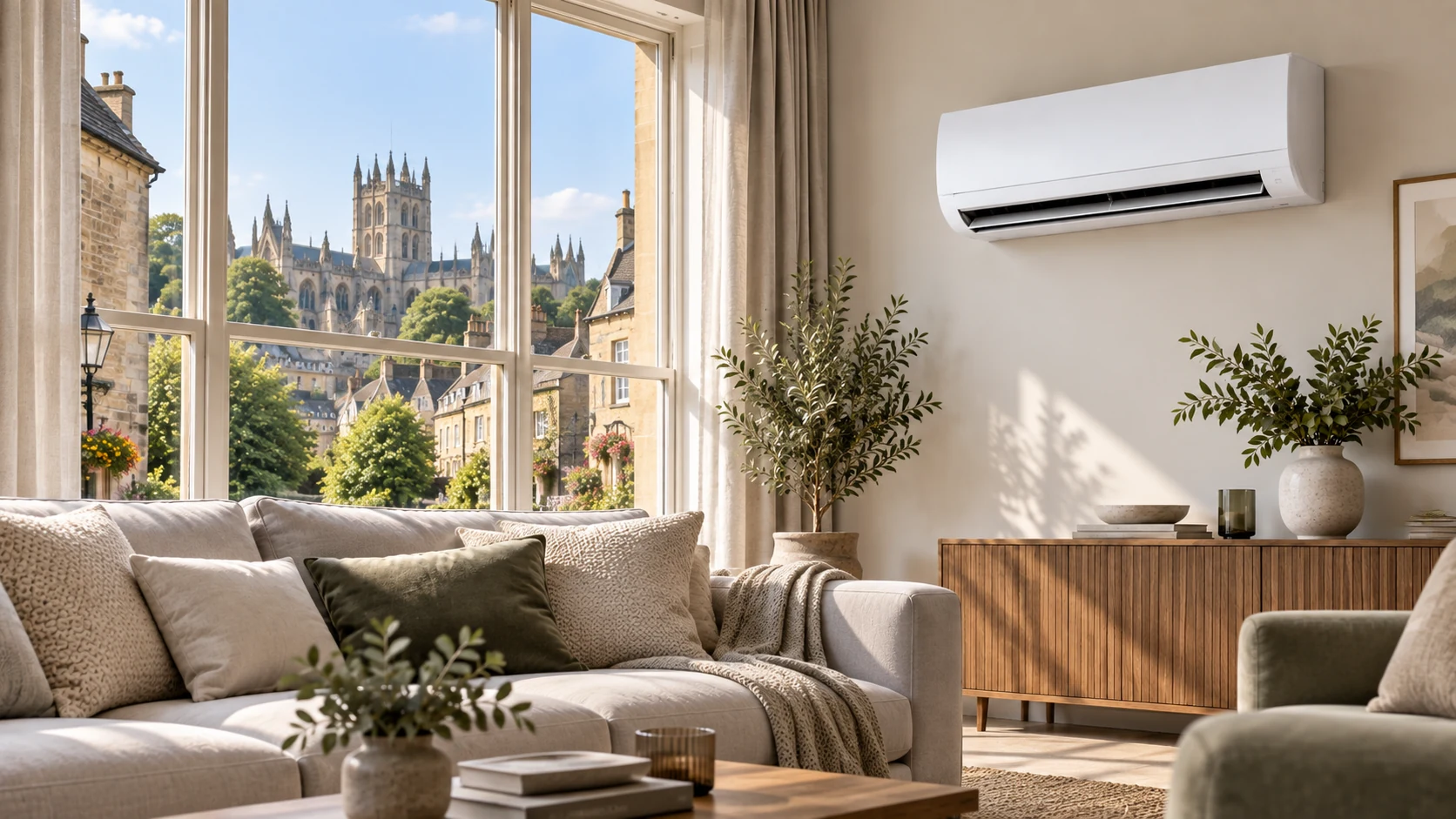
Traditional stone and solid-wall properties
Older masonry can increase heat loss and create slower thermal response.
ELUVO IN WELLS
Wells combines one of England’s most intact historic city centres with stone cottages, Georgian and Victorian housing, twentieth-century suburban streets and newer family homes on the edge of the city.
Its compact historic core, Mendip setting and varied housing mean heating and cooling work needs to be planned around the individual building. ELUVO looks at fabric, system history, room use and future upgrades together.
Local Overview
Wells is officially recognised as England’s smallest city outside the City of London, but its housing is far from uniform.
The historic core has remained broadly consistent in form since the late eighteenth century, with the Cathedral, Bishop’s Palace, market area and surrounding streets forming a highly protected townscape.
The Wells Design Guide records later nineteenth-century growth around Priory Road, Princes Road, Tucker Street, Ethel Street, Ash Lane and Bath Road.
Twentieth-century expansion then created broader suburban housing outside the historic core.
That produces several distinct home-comfort conditions.
A central stone property can have traditional masonry, sensitive external elevations and constrained routes.
A Victorian or Edwardian villa may have larger rooms and higher hot-water demand.
A later suburban house may be much easier physically but still contain ageing radiators, extensions and controls.
A newer home may lose less heat in winter while experiencing stronger summer heat retention.
ELUVO therefore treats Wells as a city where heritage, construction period and site position all matter.
Comfort Problems
Older masonry can increase heat loss and create slower thermal response.
Flues, condensate routes and outdoor units may need careful positioning.
Multi-storey properties can benefit from better zoning and emitter review.
The boiler may be newer than the radiators, pipework and controls.
A newer rear space can behave very differently from the original house.
Roof gain and modern insulation can create summer discomfort.
Access and service routes can be more restrictive near the central city.
Boiler Installation
In a central historic property, route planning and building sensitivity can be as important as appliance choice.
In later family housing, the main issues may be hot-water demand, radiator condition and extensions.
ELUVO reviews:
The replacement should suit the home as it is used now.
Boiler Service & Repair
Routine boiler servicing helps maintain a clear record of appliance condition.
Where pressure loss, lockouts, uneven heating or inconsistent hot water are already present, diagnosis may need to extend beyond the boiler.
ELUVO separates routine servicing from fault investigation and explains the evidence before recommending replacement.
Air Conditioning
Top-floor rooms, loft conversions, home offices and glazed extensions can all become uncomfortable during warm periods.
Newer homes can also retain heat well after the outside temperature falls.
Heat Pump Readiness
A historic property is not automatically unsuitable for low-temperature heating.
But readiness must be assessed carefully.
ELUVO reviews:
A later suburban house may offer an easier route.
A central stone property may need more work on emitters, heat loss and external-unit placement.
Home Climate Assessment
A Wells home may contain original stone walls, replacement windows, a modern boiler, old radiators, an extension and upgraded insulation.
The ELUVO Home Climate Assessment can identify:
The purpose is to prioritise the right next step.
ELUVO Care
ELUVO Care connects service records, planned maintenance and future recommendations across heating and cooling systems.
Local Neighbourhoods
The most sensitive part of the city contains highly significant historic buildings and tightly controlled townscape.
Visible external work must be considered carefully.
Historic commercial/residential buildings can have mixed uses, upper-floor accommodation and restricted routes.
The Wells Design Guide records nineteenth-century expansion here, including larger semi-detached villas.
These homes can have substantial room volumes and hot-water demand.
Later nineteenth-century residential growth created another layer of established housing outside the earliest core.
Housing close to the northern side of Wells sits nearer the Mendip landscape and can include a mix of established and later suburban property.
The Design Guide records development extending eastward along Bath Road, creating another transition from historic city to later residential growth.
Newer homes can have stronger insulation and more predictable layouts, but summer heat retention and future heat-pump planning become more important.
Planning & Property Status
The Wells Conservation Area protects the historic core and has been in place since 1970.
Somerset Council advises that additional controls can apply in conservation areas and that consent may be required for changes that would be permitted elsewhere.
That does not mean all Wells homes are subject to the same controls.
Later suburban and edge-of-city housing can sit outside the central conservation area.
For heating, cooling and heat-pump work, check:
ELUVO can assess technical routes.
Formal planning and listed-building decisions remain with Somerset Council.
FAQ
Yes, potentially. The system needs to reflect the building’s heat loss, emitters and heritage context.
Not automatically. Internal replacement can be straightforward, while visible external changes may need additional checks.
Potentially. Outdoor-unit location, visibility, route, sound and property status all matter.
Some are strong candidates; others may need emitter, fabric or control improvements first.
No. Boiler output should follow actual demand.
Potentially, especially where rooms and floors are used differently.
Often physically, but controls, emitters, hot-water demand and summer overheating still matter.
Use a quote where the required service is clear. Use the Assessment where several connected issues need to be prioritised.
The ELUVO Approach
Historic character and modern comfort are not opposites.
ELUVO connects boiler installation, servicing, air conditioning, heat-pump readiness and whole-home planning around the individual property.
ELUVO service areas
Talk To ELUVO
Tell us what you need help with. We will review your enquiry and confirm whether a quote, service visit or technical assessment is the right next step.
Free initial phone consultation.
Professional Home Climate Assessments start from £95 and are credited back when you proceed with installation.